Why Conversations About Desire Often End in Silence or Conflict
You may share deep love, yet discussing power dynamics, kinks, or emotional needs can feel terrifying. Fear of judgment or rejection leads many couples to avoid the topic — breeding resentment or confusion.
That’s where a couple BDSM test changes everything. It provides an objective, blame‑free third perspective. Instead of “you vs. me”, the report becomes a shared map for curiosity and consent.
“Seeing our 45% compatibility score wasn’t scary — it was honest. The radar showed we both love Voyeurism (79%!). That gave us a place to start.” — iSensualFlow user
Safety First: Understanding SSC & RACK Principles
Healthy BDSM exploration is built on informed consent and emotional safety. Two essential frameworks:
SSC — Safe, Sane & Consensual
All activities must be physically safe, mentally responsible, and enthusiastically agreed upon.
RACK — Risk-Aware Consensual Kink
Recognises that any intimacy carries risk. The goal is open negotiation, risk awareness, and mutual acceptance. Learn more about RACK.
Our couples bdsm quiz follows these guidelines — designed to empower, not pressure.
What a Real Couple Compatibility Radar Reveals (Report ID: y2a3cri9)
🔬 Founder / real user breakdown:
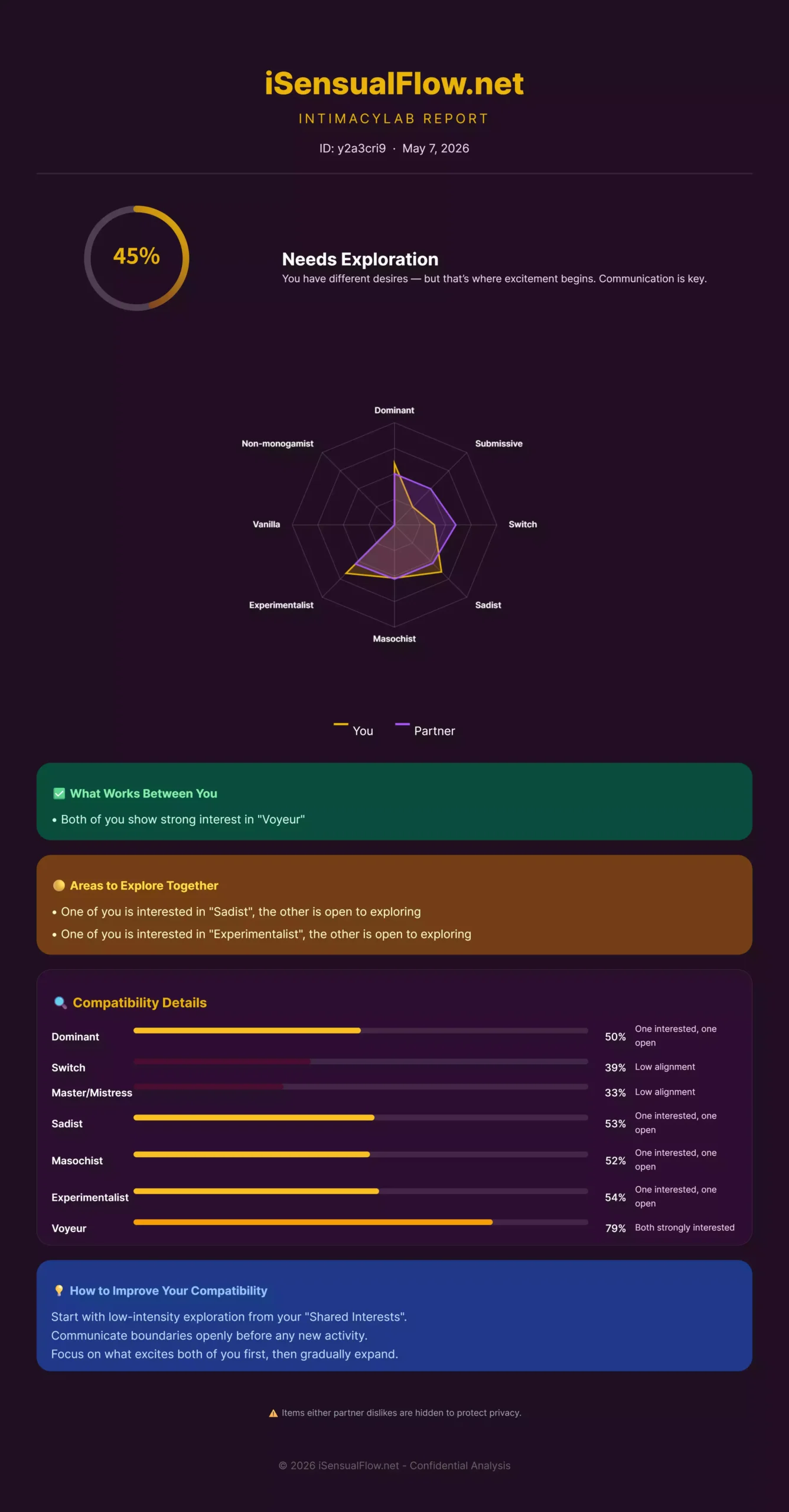
The report above comes from an actual couple who took our test. Their overall compatibility score: 45% – “Needs Exploration”. Instead of disappointment, the system highlights excitement: “You have different desires — but that’s where excitement begins. Communication is key.”
- ✔ Strongest shared interest: Voyeur – both scored 79%.
- ✔ What works between them: Mutual strong interest in Voyeur.
- ⚠️ Areas to explore together: Sadist (one interested, other open) and Experimentalist (one interested, other open).
- 📊 Detailed scores: Dominant 50%, Switch 39%, Sadist 53%, Masochist 52%, Experimentalist 54%.
The radar doesn’t label couples as “good” or “bad”. It shows where curiosity aligns and where negotiation is needed. This particular couple now knows: start with low‑intensity Voyeur activities, then gently explore Sadist/Experimentalist with clear boundaries and safewords.
According to the report’s advice: “Start with low‑intensity exploration from your Shared Interests. Communicate boundaries openly before any new activity. Focus on what excites both of you first, then gradually expand.” Items either partner dislikes are hidden to protect privacy.
After the Report: How to Actually Improve Your Relationship
Numbers are just data. Real change happens when you discuss them with emotional intelligence. We recommend pairing your results with The 5 Love Languages (Gary Chapman):
- Words of affirmation → verbal reassurance before/after scenes
- Physical touch → grounding cuddles & aftercare rituals
- Acts of service → preparing the space or bringing water
- Quality time → dedicated debriefing without distractions
For the couple above, their shared Voyeur interest (79%) can be explored through consensual watching scenarios, while Sadist/Experimentalist should be taken slowly, with weekly check‑ins.
Invite your partner and unlock your personalized compatibility report, radar overlap insights, and relationship guide.
Start the Couple Compatibility Test →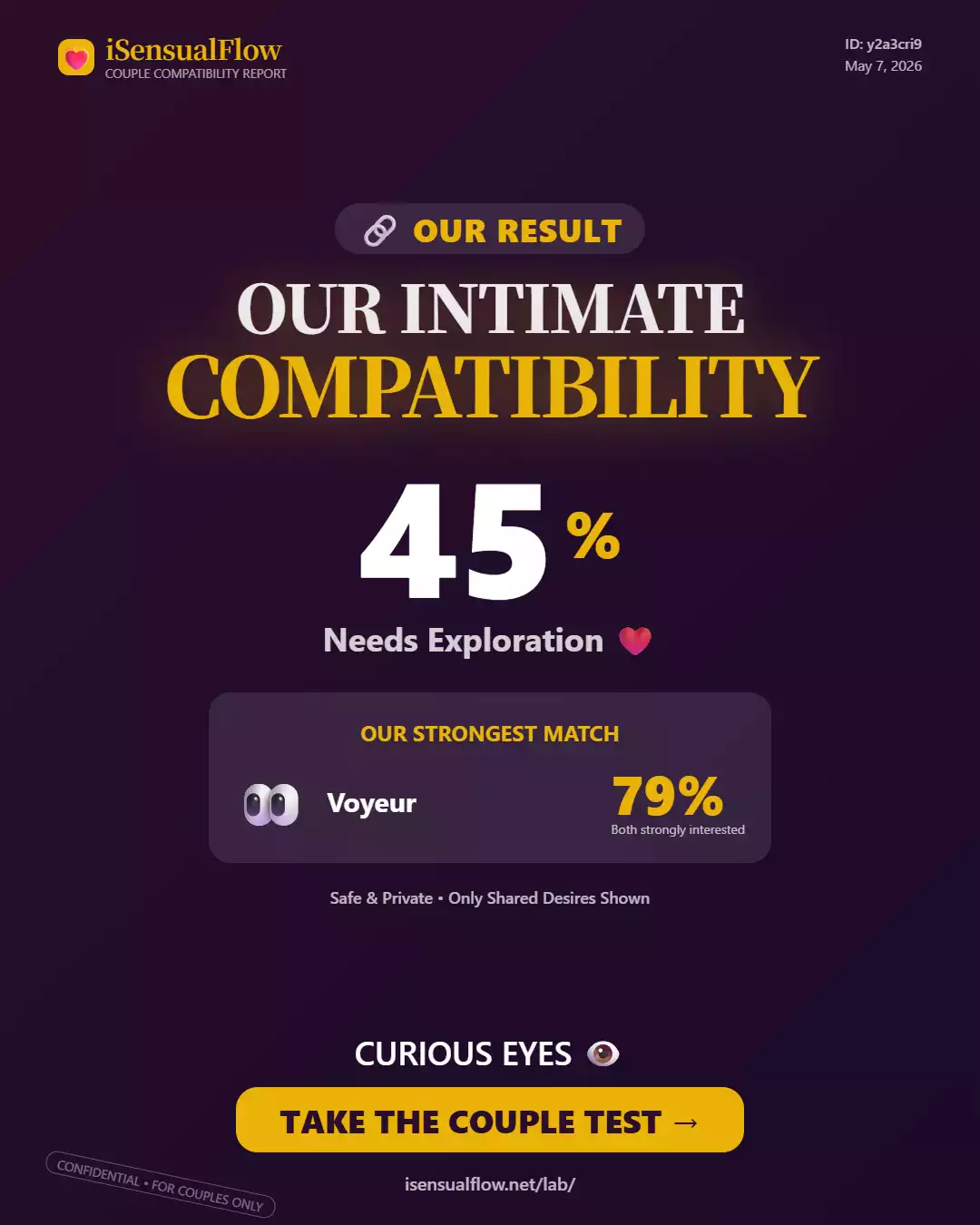
Take the test together and get your own shareable poster.
Free Download: IntimacyLab Full Report (PDF)
Want to study the complete report example? Download the original PDF that includes all dimensions, percentages, and privacy-protected insights.
18 roles, radar, consistency
Recommended Beginner Exploration Tools
Based on the example report (45% Needs Exploration with high Voyeur), many couples begin with simple, communication-focused tools:
🛠️ Beginner-Friendly Ideas
- Soft restraint kits (silk ties, velcro cuffs)
- Comfortable blindfolds
- Aftercare comfort items (blankets, massage oil)
- Communication card games
🧠 Important Reminders
- Never skip consent discussions
- Move slowly and check in often
- Respect emotional boundaries
- Use safewords clearly
Frequently Asked Questions
📚 References & Further Reading
- Wismeijer, A. A. J., & van Assen, M. A. L. M. (2013). Psychological characteristics of BDSM practitioners. Journal of Sexual Medicine, 10(8), 1943–1952. View Study
- Moser, C., & Kleinplatz, P. J. (2022). BDSM and Mental Health Research: A Review. Current Sexual Health Reports.
- Chapman, G. (1992). The 5 Love Languages: The Secret to Love that Lasts. Northfield Publishing. Official Resource
- The National Coalition for Sexual Freedom (NCSF). Consent and Safety: The SSC & RACK Frameworks.
- iSensualFlow IntimacyLab Case Study: Internal Report ID: y2a3cri9 (Anonymized Couple Data for Compatibility Mapping).