A BDSM test is a standardized self‑report inventory designed to map your inclinations across power dynamics, sensation‑seeking, and relational structures. Unlike viral TikTok quizzes, the best official BDSM test uses item‑response theory, weighted dimensions, and behavioral consistency checks. Our IntimacyLab engine processes answers through 7 algorithmic layers — from raw scoring to entry‑mode filtering — delivering a radar chart and 18 personality‑based role scores (Dominant, Submissive, Switch, Sadist, Masochist, Owner, Pet, etc.).
⚠️ Why Most Online BDSM Tests Are Inaccurate
- ❌ No normalization (raw scores only)
- ❌ Penalizing high dominance + submission (misclassifying Switch users)
- ❌ No consistency model → random answers look “valid”
- ❌ Clickbait results instead of structured profiles
IntimacyLab avoids all of these through weighted dimensions, contradiction detection, and transparent formulas.
🧠 Psychological Foundations: How BDSM Traits Relate to Personality
Many modern BDSM tests are loosely inspired by frameworks like the Big Five Personality Traits (Openness, Conscientiousness, Extraversion, Agreeableness, Neuroticism). For example:
- High openness → correlated with kink exploration
- Low agreeableness → sometimes linked to dominant roles
- Attachment style → influences submissive or caregiving dynamics
Source: Li (2024), Wismeijer & van Assen (2013)
We publish our core logic: after normalization, Switch = 100 – |dom – sub| blended with raw switch answers. Consistency does not penalize high dom+sub (that’s a valid Switch). Penalties only occur for genuine contradictions (kink+vanilla, poly+vanilla) or extreme opposite answers within the same dimension. See the flow below.
🔍 IntimacyLab Algorithm: How We Precisely Measure Your Preferences
Cross‑weighting example: Sadist = 65% kink + 35% dominance; Masochist = 65% kink + 35% submission. This allows both high scores — a Dom‑Masochist is a valid profile. Our consistency model includes Signal 1 (semantic contradictions: kink↔vanilla), Signal 2 (within‑dimension variance), Signal 3 (extreme opposite answers +3 and −3). Final consistency is diagnostic only — does not alter role scores.
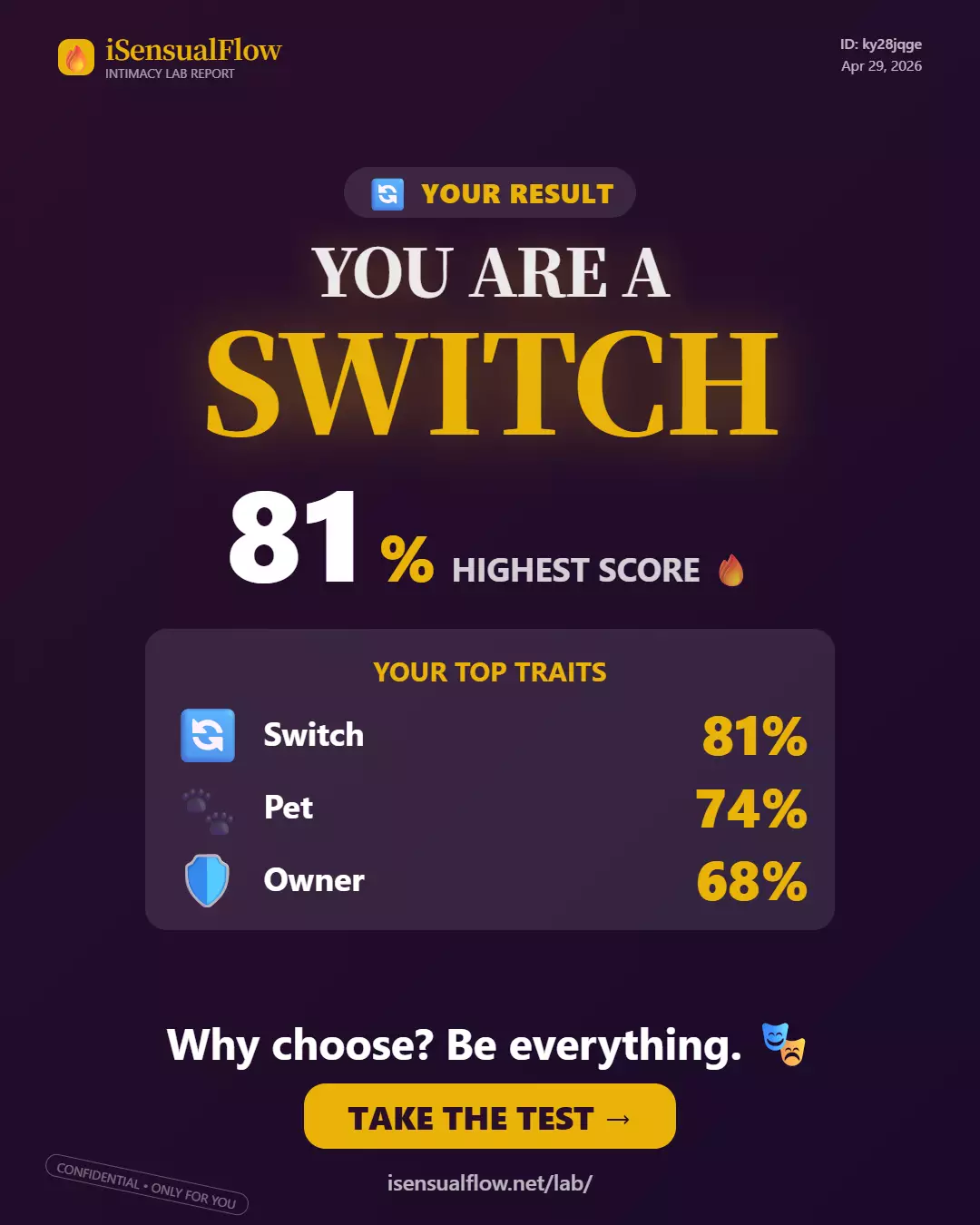
Your BDSM Test Report: Real Founder Case (Switch 81%)
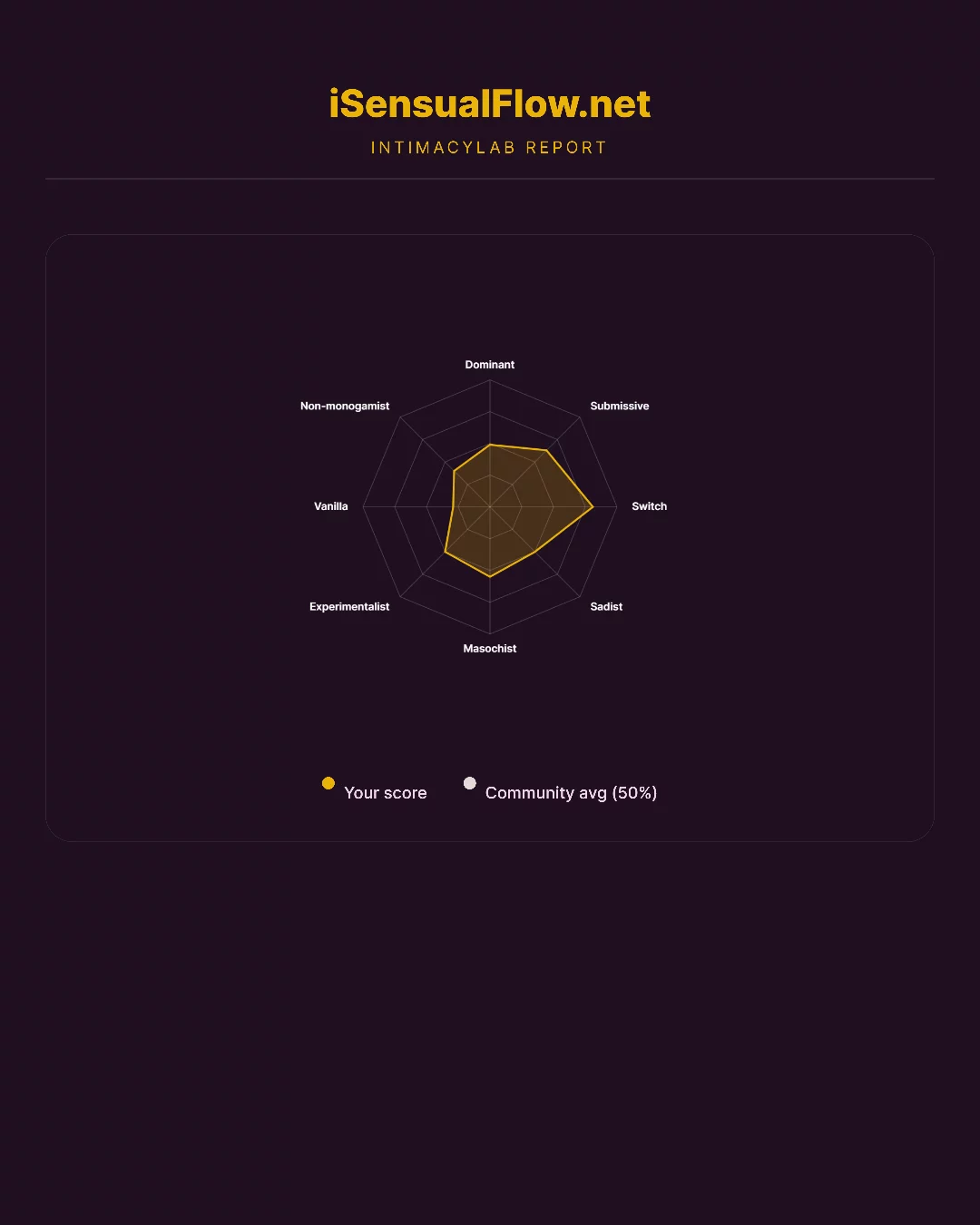
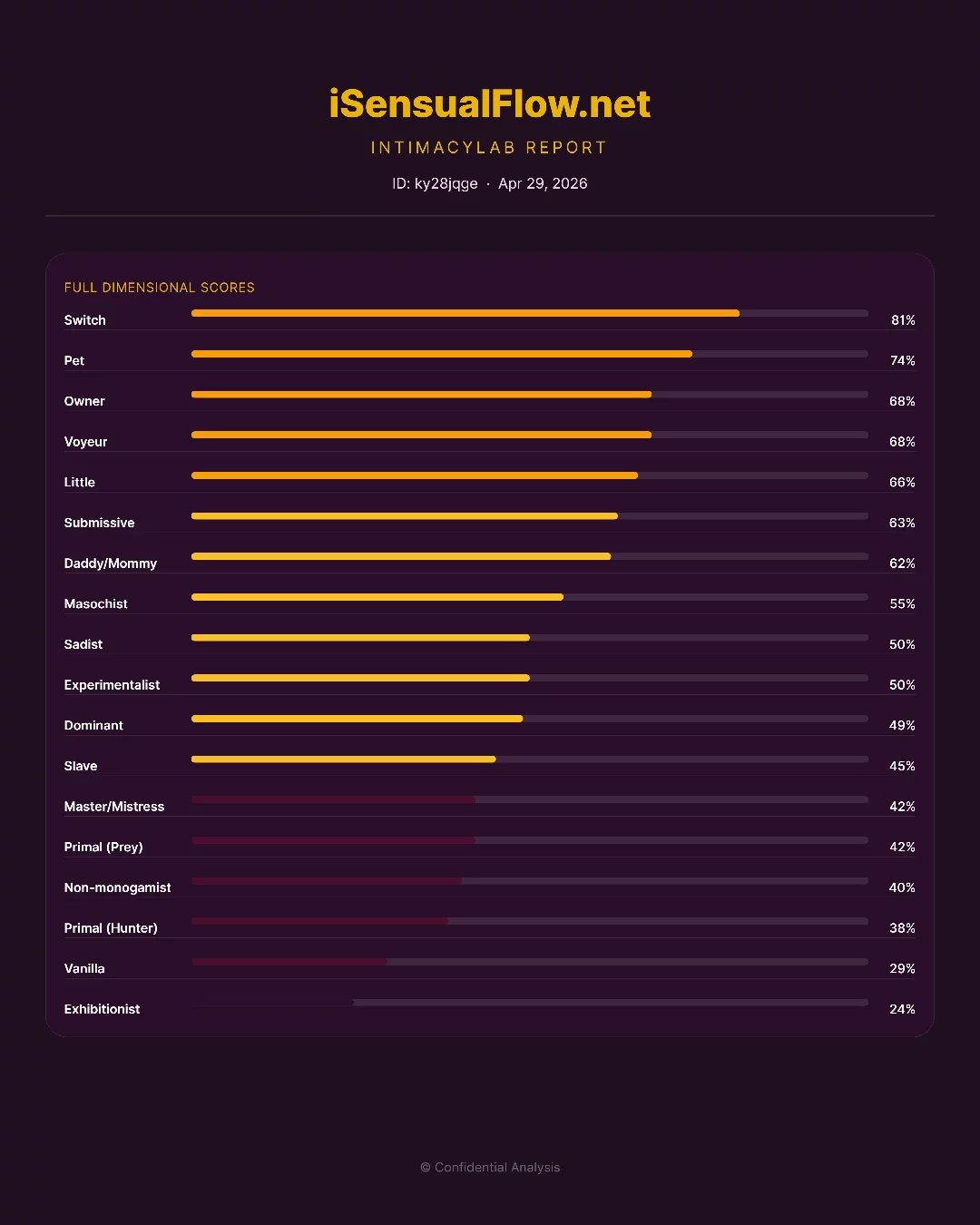
18 roles, radar, consistency
Profile deep‑dive (ID ky28jqge): Switch = 81% (computed as spectral + question blend). High Pet (74%), Owner (68%), Voyeur (68%), Little (66%). This reveals a playful, caregiving & receptive archetype with power fluidity. Dominant at 49% and Submissive at 63% reinforce the switch identity without internal contradiction. Low Exhibitionist (24%) paired with high Voyeur (68%) indicates preference for watching rather than being watched — a coherent pattern. Such reports help individuals negotiate dynamics, explore pet/owner roles, and understand their unique intersection of kink identity.
Standard vs. Full Version: Which one fits you?
| Feature | Standard BDSM Test | Full BDSM Test (Academic) |
|---|---|---|
| ⏱️ Duration | ~30 questions (3‑4 min) | ~74 questions (~15 min) |
| 📊 Core dimensions | Dom, Sub, Switch, Kink, Vanilla + top 5 roles | All 11 base dims + 18 detailed roles (Brat, Master, Primal, etc.) |
| 🎯 Precision | High (quick orientation) | Academic‑grade + consistency analysis + percentile comparison |
| 🧾 Report includes | Radar + top 5 role list | Full 18‑role ranking, consistency flags, component scores |
✨ In just 3 minutes, you’ll get:
✔ A radar chart of your personality | ✔ Your top BDSM role | ✔ A consistency score | ✔ Hidden traits you didn’t expect
Accuracy & Psychology: Why Our Test Stands Out
The iSensualFlow BDSM test is not a medical diagnosis — it is a validated self‑awareness instrument. Accuracy comes from (1) dimensional weighting based on community‑driven calibration, (2) consistency scoring that flags random or contradictory patterns, and (3) transparency of formulas. Many online tests lack polarity normalization or penalize high dom+sub incorrectly — we avoid that entirely.
Research‑Backed Trust
- Wismeijer & van Assen (2013): BDSM practitioners show higher openness & well‑being
- Li (2024): attachment style links to BDSM roles
- Moser & Kleinplatz (2022): consensual kink is non‑pathological
What We Don’t Do
- No data selling or registration
- No penalising Switch profiles as “contradictory”
- No fake “pathology” framing
💑 What If You’re Exploring With a Partner?
If you’re in a relationship, a single test only tells half the story. Try our BDSM Couple Compatibility Test to see how your preferences align.
Compare With Your PartnerFrequently Asked Questions
📚 Scientific References
- Wismeijer, A. A. J., & van Assen, M. A. L. M. (2013). Psychological characteristics of BDSM practitioners. Journal of Sexual Medicine, 10(8), 1943–1952. Link
- Li, S. (2024). The Psychology of Kink: Association Between Attachment Style and BDSM Identity. Archives of Sexual Behavior, 53, 2269–2276. Springer
- Moser, C., & Kleinplatz, P. J. (2022). The Biology of BDSM: A Systematic Review. Journal of Sexual Medicine, 19(1), 144–157.